| 16.03.2011 |
| |
The following is an excerpt from the Bank of Israel Annual Report, which will be published on March 30, 2011:
Will the Israeli economy become infected with the "Dutch Disease"?
The natural gas discoveries and their effects on the current account and the real exchange rate
|
|
| |
| To view this press release as a WORD file - Click here |
|
| |
|
|
| |
 |
In recent years domestic natural gas is replacing imported fossil fuels at a scale of 1 to 2 billion dollars a year. The gas fields that have been discovered in the past two years are expected to double the scale of replacement after 2015. |
| |
An improvement of around one billion dollars in the current account as a result of the production of gas in Israel leads to an appreciation of only around one percent in the real equilibrium exchange rate. |
| |
The negative impact on the real exchange rate is large enough to affect the tradable sector adversely––an effect known as the Dutch Disease––only if an industry of exporting natural gas develops, and additional fields are discovered. |
| |
One of the ways of mitigating the effects of the Dutch disease is to establish a Sovereign Wealth Fund that will invest abroad the government income from gas production. |
| Until 2000 Israel did not possess a large volume of domestic energy sources. Except for a brief period in the 1970s during which significant quantities of crude oil were produced from the oilfields in Sinai, almost all the energy materials required for the economy were imported. This placed a heavy burden on the economy, particularly in the years of high energy prices. |
| This situation has changed in the past decade. Since 2004 domestic natural gas is being produced from the "Yam Thetis" field off coastal Ashkelon and is being used to produce electricity. In the past two years two large natural-gas reservoirs have been discovered in deep water off Israel's northern coast: "Tamar" and "Leviathan". These discoveries significantly change the energy-economy picture by providing enough natural gas to meet Israel’s needs well into the future, and possibly even for export. |
| In recent years the domestic natural gas has allowed the economy to reduce imports of energy materials, and this process is expected to gain momentum. These developments will lead to a growth in the surplus in the current account and to appreciation in the real exchange rate, and in this respect they are liable to affect the exports of the other industrial sectors adversely the phenomenon known as the Dutch disease. An empirical assessment undertaken by the Bank of Israel has quantitatively estimated the possible impact of the discovery of natural gas on the economy, including examining the extent to which the economy will be affected by the Dutch Disease. |
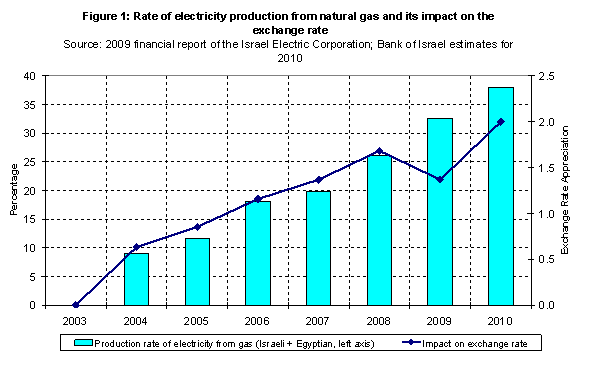
| In order to examine directly the present and future impact of domestic gas production on the exchange rate, we examined the impact of an increase in the export of raw materials, particularly natural gas, on the real exchange rate in several countries that export natural gas. The results indicate a significant impact of an increase in the export of natural gas on the real exchange rate. On the quantitative significance in the case of the Israeli economy, the estimates obtained show that the export of one billion dollars of gas a year, leading to a 1.5 percent overall increase in exports—will lead to appreciation of around 0.8 percent in the real exchange rate. Figure 1 shows the rise in the share of electricity produced by means of gas in recent years, and its cumulative effect on the real appreciation of the local currency, as derived from estimating the regressions, which until 2010 totaled 2 percent. |
| The conclusion arising from the examination is that in the Israeli case the use of natural gas for domestic needs will have only a relatively small impact on the real exchange rate. According to our present projections, anatural gas will replace imports to a value of about 3 billion dollars at the most beyond the substitution up to the present time. Because the substitution of imports has already been partially realized, and the future impact of existing fields has also been taken into account in the markets, most of the impact on the exchange rate has already occurred and has probably contributed to the real appreciation of the past two years. |
| If, however, the "Leviathan" field is used for exports, the impact could be greater. Because of uncertainly regarding the volume of exports, it is not possible today to quantify the impact of a scenario of this kind on the exchange rate. Further, if there were to be additional discoveries of natural gas, it is very likely that Israeli will become a gas exporter. |
| A factor that could counterbalance the impact of the Dutch disease is the establishment of a Sovereign Wealth Fund for the purpose of fiscal saving, a fund that would invest abroad the income from gas exports. This could help also in the intergenerational distribution of the benefits from the discovery and exploitation of this natural resource. |
| |
|
| |
|
| |
|
|
| |
|
|
| |
|