| 07.9.2008 |
| |
New Research in the Bank of Israel:
The effect of the liquidity constraint on the access to higher education
|
|
| |
|
|
 |
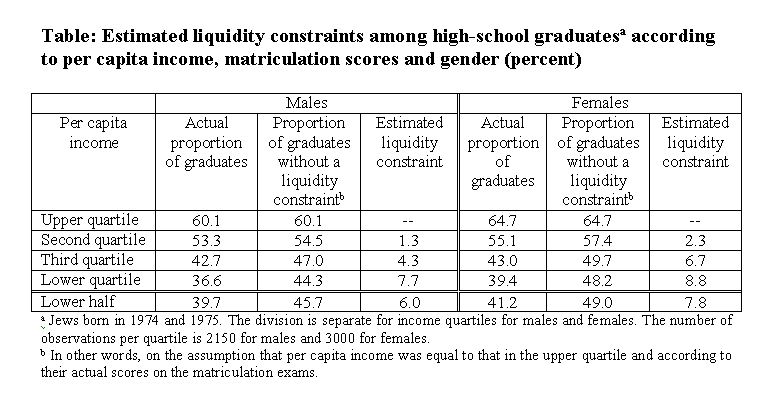
The proportion of first-degree holders among high-school graduates who come from low-income families (with an income of less than the median) is 41 percent, compared with 63 percent among high-school graduates from rich families (from the top quartile of the income distribution). |
| |
If high-school graduates from those low-income families had not found it difficult to finance their first-degree studies (in other words, in the absence of a liquidity constraint), the proportion of first-degree holders among them would be about 7 percentage points higher (i.e., 48 percent). |
| |
The contribution of an academic education to the income of female high-school graduates from poor families is higher than that of female high-school graduates from rich families with similar matriculation scores. Among males, no difference was found. |
| |
The liquidity constraint has far greater effect on Moslem men than on the Jewish population. |
| |
Both male and female students from the lower quartile of the income distribution complete their first degree about five months later than rich students with similar matriculation scores. |
| |
The authors consider that provision of subsidized student loans or scholarships to students from low-income families will improve their chances of obtaining a first degree. |
| A study conducted by Dr. Yoav Friedman and Roni Frisch of the Bank of Israel's Research Department examined whether (and to what extent) poor segments of the population decide not to participate in higher education in Israel due to the difficulty in financing their studies, i.e. due to a liquidity constraint. The poor, who lack the necessary financial means, are forced to finance their investment in higher education through expensive loans, which in many cases make the investment unworthwhile for them. A liquidity constraint constitutes a market failure that justifies a pro-active government policy to remove it. This can be accomplished through, for example, subsidized student loans or graduated tuition. |
| The gap in rates of participation in higher education between students from rich and poor families can be attributed to two factors: liquidity constraints among low-income families and the fact that the attainment of a higher education raises the income of the poor less than that of other groups due to gaps in ability that have accumulated over time (including innate abilities). The study examines the rate of higher-education participation among liquidity-constrained individuals relative to that among non-constrained individuals with similar levels of scholastic achievement in high school. It is assumed that matriculation scores provide a good estimate (i.e. an unbiased estimate) of the expected contribution of an academic education to income. |
| The estimation of the liquidity constraint based on achievement in high school indicates that the chances of individuals who grew up in poor families to complete a first degree are lower than those of individuals from rich families with similar matriculation scores. In order to provide support for the claim that this gap is a result of a liquidity constraint, the hypothesis was tested that, given the student's achievements, there is no relation between return to education and family income. This hypothesis was found to be correct for men but was rejected for women, among whom the return to higher education was higher among women from poor families than among women from rich families with similar achievements in high school. Therefore, in the absence of a liquidity constraint, the proportion of female high-school graduates from poor families would be even higher than the proportion from rich families with similar matriculation scores. |
| It was found that among Jewish males, the chances of an individual from the lower half of the income distribution completing a first degree were lower by 6 percentage points than those of a student with similar matriculation scores who grew up in a family in the upper quartile of the income distribution (see table). A similar comparison among Jewish women found an even larger gap of 7.8 percentage points (as mentioned, this gap does not fully reflect the effect of a liquidity constraint among women). It was also found that (Jewish) male and female students from the lower quartile of the income distribution delay the completion of their first-degree studies by about five months relative to students from the upper quartile with similar matriculation scores. It is well-known that a delay in the completion of first-degree studies reduces the profit from a first degree and it is likely that this delay is the result of a liquidity constraint. It was found that the liquidity constraint among Moslem men (who had attended high school) was substantially more severe than that among Jewish men, though the conclusion for Moslem women was not clear-cut.[1] |
| Another way of estimating the effect of a liquidity constraint on the access to academic education is to examine the effect of a reduction in university and college tuition. In 2002, tuition for institutions of higher education was reduced by 14 percent, which could be expected to have increased the rate of participation for liquidity-constrained individuals. However, there is no evidence of such an increase in the proportion of students from low-income and large families among the general population of students in higher education. This does not, however, weaken the claim regarding the existence of a liquidity constraint in attaining a higher education for two reasons: First, the effect of the tuition reduction on liquidity-constrained individuals who had not intended to attain a higher education is likely to take place gradually and over a long period of time while we were able to examine data for only a short period following the reduction in tuition. Second, the expectations of further reductions in tuition (which were announced by the government) likely encouraged some liquidity-constrained individuals who had intended to acquire a higher education to delay the start of their studies. |
|
| |
|
|
| |
| * |
The views expressed in the paper are those of the author, and do not necessarily reflect those of the Bank of Israel. |
| 1 |
The analysis relates to the period prior to the reduction in tuition fees in 1992. |
|
| |
|