| 3.10.2006 |
| |
| Banking Supervision Department's surveillance of the implementation of the new directive on credit arrangements: |
|
| |
| There has been a considerable improvement in the composition and pattern of credit consumption in current accounts and overdraft facilities following the indoctrination of the directive regarding the prohibition of exceeding credit limits: |
 |
Approved credit arrangements have increased from around NIS 55 billion in December 2005 to around NIS 70 billion in July 2006. |
| |
This increase in approved credit (and its availability to the public) is not accompanied by an increase in bank customers' overdrafts; on the contrary, the balance of overdrawn accounts has contracted from around NIS 39 billion to around NIS 36 billion. |
| |
Concurrently, the composition of the credit has improved considerably; credit within approved arrangements has grown from around NIS 27 billion in December 2005 to around NIS 30 billion in July 2006, while credit outside the arrangements has fallen sharply from around NIS 12 billion in December 2005 to around NIS 6 billion in July 2006. |
| |
There was an increase in credit for an allotted period, from around NIS 150 billion in December 2005 to around NIS 164 billion in July 2006. The average interest rate on this credit stood at around 7.5 percent, significantly lower than the interest rate on current accounts (including within the credit arrangement). |
| Since July 1, 2006, the banks have been required to implement the new Banking Directive 325 on Credit Arrangements, which deals with the management of credit lines in current accounts, and according to which the banks cannot allow their customers to deviate from the credit arrangements on their current accounts and overdraft facilities. If a bank and a customer wish to extend this credit, then they must extend the credit arrangement, rather than deviate from it. In preparation for implementing this directive, throughout 2005 and during the first half of 2006, the banks unilaterally extended their customers credit arrangements, suitable to their customers' needs and repayment capabilities. |
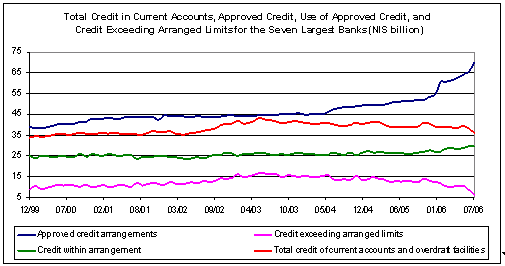
| The following chart shows the average levels of credit in current accounts in the seven largest banks, between December 1999 and July 2006. Some of the data are presented in the appendix. |
|
| |
|
|
| |
| The data show a consistent and rapid increase in deviations from approved credit arrangements from the end of 1999 (NIS 8.9 billion) until June 2003, when it reached more than NIS 16 billion. The level of deviations then held steady and even fell gradually to around NIS 12 billion at the end of 2005, after which it fell sharply to some NIS 6 billion in July 2006. Credit arrangements grew over the years, though the increase was particularly marked in the past half year, rising from NIS 55 billion in December 2005 to around NIS 70 billion in July 2006. This increase in credit arrangements did not bring with it an additional increase in customers' overdrafts. These overdrafts actually fell, from around NIS 39 billion in December 2005 to around NIS 36 billion in July 2006. There was also a significant change in the composition of this credit: credit within the arrangements grew (from around NIS 27 billion in December 2005 to around NIS 30 billion in July 2006) while the deviations from these arrangements fell sharply (from around NIS 12 billion in December 2005 to around NIS 6 billion in July 2006). |
| The Banking Supervision Department notes that the data clearly show that the aim of the directive––to bring credit within the arrangement framework––has indeed been achieved and the behavior of current accounts in Israel is moving closer to the is the existing in other countries. This objective was reached without a credit crunch which many had feared; on the contrary, despite a considerable increase in the availability of credit due to the banks' expansion of credit arrangements, customers utilized it prudently and did not exploit the excess credit that became available. This consumer behavior was induced by the fact that the credit within an approved arrangement is a more expensive form of credit, particularly as a higher interest rate prevails on the additional credit extended by the banks under the new arrangements than the credit under the previous arrangements. Credit in current accounts and overdraft facilities are suitable for bridging occasional credit needs for short periods of time. However, for longer periods it is advisable to take term credit, which generally carries a lower interest rate than that on overdrafts. Indeed, as overdraft facilities has fallen, term credit has grown consistently in recent years, and particularly most recently, growing from around NIS 150 billion in December 2005 to around NIS 165 billion in July 2006. |
| |
| As mentioned earlier, as part of their preparation for implementing the new directive, the banks unilaterally extended credit arrangements to some of their customers. These arrangements covered some 20 percent of all accounts that required credit arrangements (among the largest banks: some 700,000 accounts out of a total 3.2 million). The Banking Supervision Department consistently reminds all that these unilateral credit arrangements are valid only until January 1, 2007 and that by then, alternative arrangements––acceptable to both bank and customer––must be reached. Customers are advised to compare offers among banks, to take advantage of the increasing competition, to negotiate terms with the bank, and to choose the best offer for him or her. |
| There has been no significant change in the past month in the data regarding banks' preparation for the new directive in terms of the number of accounts (as opposed to the balance of credit as detailed above) with approved credit arrangements. Data for the five largest banks as of August 31, 2006 is shown in the appendix. It should be noted that though the number of accounts which have exceeded their credit limits may be large, for most of these, the sums of deviation are relatively small. |
|
| |
| Date |
Total approved credit arrangements |
Total credit deviations |
Total approved credit taken |
Total credit in current accounts and overdraft facilities |
Credit for allotted periods |
| |
NIS billion |
| 31/12/1999 |
38.9 |
8.9 |
24.9 |
33.8 |
64.88 |
| 30/6/2000 |
40.3 |
10.5 |
25 |
35.5 |
80.24 |
| 31/12/2000 |
42.8 |
10.1 |
25.6 |
35.7 |
94.35 |
| 30/6/2001 |
43.4 |
10.1 |
25.6 |
35.7 |
104.88 |
| 31/12/2001 |
44.7 |
11.2 |
25.1 |
36.3 |
108.56 |
| 30/6/2002 |
43.9 |
12 |
24.4 |
36.4 |
108.16 |
| 31/12/2002 |
44.6 |
14.5 |
26.1 |
40.7 |
111.86 |
| 30/6/2003 |
44.6 |
16.2 |
26.1 |
42.4 |
115.28 |
| 31/12/2003 |
45.3 |
14.8 |
26.4 |
41.2 |
113.15 |
| 30/6/2004 |
47.5 |
13.6 |
26.7 |
40.2 |
119.83 |
| 31/12/2004 |
49.6 |
13.8 |
27.3 |
41 |
126.58 |
| 30/6/2005 |
51.1 |
12.6 |
26.5 |
39.1 |
138.49 |
| 31/12/2005 |
55.1 |
12.1 |
27.1 |
39.2 |
150.32 |
| 30/6/2006 |
65.6 |
8.7 |
29.5 |
38.2 |
161.33 |
| 31/7/2006 |
69.9 |
6.2 |
29.7 |
35.8 |
164.51 |
|
| |
| |
Private customers |
Business customers |
Total bank customers |
| small |
large |
| 31.8.2006 |
31.8.2006 |
31.8.2006 |
31.7.2006 |
31.8.2006 |
| Total no. of accounts ('000) |
4,459 |
470 |
115 |
5,040 |
5,043 |
| Total no. of accounts needing credit arrangement ('000) |
2,826 |
290 |
82 |
3,189 |
3,198 |
| Proportion of accounts for which agreement signed (%) |
68 |
89 |
58 |
68 |
69 |
| Proportion of accounts with unilaterally fixed credit line (%) |
22 |
5 |
16 |
23 |
21 |
| Proportion of accounts for which customers were requested to make a credit agreement (%) |
10 |
6 |
26 |
9 |
10 |
| Proportion of accounts exceeding credit limit (%) |
13 |
23 |
28 |
15 |
14 |
|
| |
|