To view this message as a word file, click here.
To view this message as a pdf file, click here.
This document presents the macroeconomic staff forecast formulated by the Bank of Israel Research Department in October 2026 concerning the main macroeconomic variables—GDP, inflation, and the interest rate.[1] According to the baseline scenario, GDP excluding production abroad (which, in our assessment, better represents economic activity, see the box at the end of this document) is expected to grow by 3.4 percent in 2026 and by 5.1 percent in 2027. The inflation rate in the coming four quarters (ending in the third quarter of 2027) is expected to be 2.0 percent. Annual inflation in 2026 is expected to be 1.5 percent, and annual inflation in 2027 is expected to be 2.1 percent. The average interest rate in the third quarter of 2027 is expected to be 3.0 percent. The state budget deficit is expected to be 4.4 percent of GDP in 2026, and 4.6 percent of GDP in 2027.
The current period is characterized by a high level of uncertainty regarding a great number of parameters that may have a marked impact on the economy. The forecast is based on working assumptions that the intensity of the fighting will remain low, similar to the current level, in a way that somewhat eases the supply constraints in the economy, and that the geopolitical environment will remain tense. The forecast does not take into account the potential impact of the upcoming Israeli elections on the economy.
On the basis of these assumptions and additional assessments that will be detailed below, the forecast reflects continued convergence of GDP (excluding production abroad) toward the prewar trend, in parallel with a recovery of employment in the economy. However, even at the end of the forecast horizon (end of 2027), GDP is expected to remain below the trend line, since the supply of workers is still expected to be lower than the level derived from the prewar participation rates. In parallel, inflation is expected to become entrenched around the midpoint of the target range.
The forecast
The Bank of Israel Research Department compiles a quarterly staff forecast of macroeconomic developments based on several models, various data sources, and assessments based on economists’ judgment. The Bank’s DSGE (Dynamic Stochastic General Equilibrium) models—structural models developed in the Research Department and based on microeconomic foundations—play a prime role in formulating the macroeconomic forecast. The models provide a framework for analyzing the forces that have an effect on the economy, and allow information from various sources to be combined into a macroeconomic forecast of real and nominal variables, with an internally consistent “economic story”. The models also help analyze scenarios and policy alternatives, and thereby support the formulation of policy under uncertain conditions.
- The global environment
Our assessments of expected developments in the global economy are based mainly on projections by international financial institutions and foreign investment houses. Accordingly, we assume that GDP in the advanced economies will grow by 1.5 percent in 2026 and 1.6 percent in 2027 (compared with 1.2 percent and 1.4 percent respectively in the July forecast). We further assume that inflation in those economies will be 3.1 percent in 2026 (compared with 3.0 percent in the July forecast) and 2.6 percent in 2027 (compared with 2.3 percent in the July forecast). The interest rate is expected to be 3.5 percent at the end of 2026 (compared with 3.0 percent in the July forecast) and 3.4 percent in 2027 (compared with 2.9 percent the July forecast). The price of Brent crude oil increased significantly from $72 per barrel at the time of the July forecast to about $110 per barrel currently.
|
Table 1 Research Department Staff Forecast for 2026–2027 (annual rates of change, percenta, unless stated otherwise) |
|||||
|
|
2025 actual figures |
Forecast for 2026 |
Change from the July forecastb |
Forecast for 2027 |
Change from the July forecastb |
|
GDP |
3.5 |
5.6 |
|
7.5 |
|
|
GDP (excluding production abroad) |
2.1 |
3.4 |
|
5.1 |
|
|
Private consumption |
2.9 |
4.0 |
1.0 |
5.0 |
-1.5 |
|
Fixed capital formation (excl. ships and aircraft) |
7.8 |
10.5 |
2.5 |
5.0 |
-1.0 |
|
Public consumption (excl. defense imports) |
2.2 |
1.0 |
-1.0 |
2.0 |
1.5 |
|
Exports (excl. diamonds and startups) |
8.5 |
14.0 |
|
13.0 |
|
|
Exports (excl. diamonds and startups) (excl. production abroad) |
3.6 |
5.0 |
|
4.5 |
|
|
Civilian imports (excl. diamonds, ships, and aircraft) |
9.6 |
16.5 |
6.0 |
3.5 |
-2.0 |
|
Broad unemployment rate (average for the year, ages 25–64)c |
3.6 |
4.6 |
0.0 |
3.0 |
0.0 |
|
Adjusted employment rate (average for the year, ages 25–64)c |
78.2 |
77.3 |
-0.1 |
78.7 |
-0.3 |
|
Government deficit (percent of GDP)d |
4.6 |
4.4 |
-0.5 |
4.6 |
0.4 |
|
Debt to GDP ratio (percent)d |
67.8 |
68.0 |
-1.0 |
66.5 |
-2.5 |
|
Government deficit (percent of GDP) (excl. production abroad)d |
|
4.5 |
|
4.9 |
|
|
Debt to GDP ratio (percent) (excl. production abroad)d |
|
70.0 |
|
70.5 |
|
|
Inflation (percent)e |
2.5 |
1.5 |
-0.3 |
2.1 |
0.3 |
|
a The forecasts of the National Accounts components and of public debt are rounded to the nearest half percentage point. b For GDP and exports, the change from the previous forecast was not calculated, due to the significant revision to previous National Accounts data made by the Central Bureau of Statistics, which leads to a distortion when comparing current forecasts to previous ones. c According to the Central Bureau of Statistics definition, the broad unemployment rate includes the unemployed under the normal definition (someone who has not worked, wanted to work, was available to work, and searched for work), as well as employees who were temporarily absent from their jobs for economic reasons (including furloughed workers). Accordingly, the adjusted employment rate does not include those temporarily absent from their jobs for economic reasons. The high average unemployment rate for 2026 reflects the temporary increase in furloughed workers during Operation Roaring Lion , which reached 8 percent in the first quarter and stabilized thereafter. In the second half of 2026, it is expected to be 3 percent on average. d Alongside the commonly accepted debt to GDP ratio, we also present the debt to GDP ratio excluding production abroad in order to examine the volume of debt relative to domestic economic activity. We do this in view of the increase in production abroad by multinational corporations, which increases the measured GDP and reduces the debt to GDP ratio without necessarily reflecting a parallel increase in domestic activity. The use of adjusted indices is also common in other countries where relevant. For instance, in Ireland, in addition to the debt to GDP ratio, a ratio of debt to adjusted gross national income (GNI*) is also published, excluding certain effects of the activity of multinational corporations. e The average of the Consumer Price Index in the last quarter of the year compared with the average in the last quarter of the previous year. |
|||||
- Real activity in Israel
GDP excluding production abroad is expected to grow by 3.4 percent in 2026, and by 5.1 percent in 2027 (Table 1). The Central Bureau of Statistics recently began publishing data showing the development of GDP net of Israeli companies’ production abroad, because the production abroad component, which has grown greatly in recent quarters to about 6 percent of GDP, does not reflect core economic activity, as explained in the box below. Therefore, the economic analysis upon which the forecast is based, which was prepared using the normal tools, focuses on GDP excluding production abroad. We added a forecast for the portion of production abroad, which was prepared separately based on forecasts by investment houses and international institutions of sales growth for the significant firms producing abroad, the relevant production industries, and assumptions regarding the development of prices in those industries. Production abroad is expected to contribute about 2.2 percentage points to GDP growth in 2026 and 2.4 percentage points in 2027, as detailed in table 1. However, there is significant uncertainty, to the tune of at least percentage point upward or downward, in the assessment of this contribution, which is due to the broad range of the investment houses’ forecasts and the lack of separation in the forecasts between quantitative changes and price changes. In any case, as explained in the box below, the impact of the changes in this component on the other parameters in the forecast is not large.
Since the July forecast, there have not been any significant surprises in the economy or in the geopolitical environment. As a result, together with the examination of developments in the labor market, our assessment is that there is no significant change regarding the development of growth expected in the economy. Most of the shortage in the supply of labor is due to the fact that the labor force participation rate, mainly that of young non-Haredi Jewish Israelis, is lower than it was prior to the war, and has continued to decline during 2026, alongside stability in the unemployment rate. Within the forecast range, a gradual increase in the number of employees is expected, due to the entry of additional foreign workers and the return to the labor market of workers that left temporarily due to the war, while the unemployment rate remains stable, which will contribute to a reduction in the shortage of workers. In our assessment, the decline in surplus exports observed during 2025 will moderate within the forecast horizon in a way that is inline with the easing of the supply constraint. Our assessment is that GDP (excluding production abroad) will gradually converge toward its prewar trend, but that even at the end of the forecast horizon, at the end of 2027, it will remain below the trend line. This is because the supply of workers is still expected to be lower than the level derived from the prewar trend, mainly due to the slow recovery of the participation rate.
In our assessment, demand in the economy will expand, supported by the decline in the interest rate environment and in the risk premium following the end of intensive war. This process is supported by the recovery in the construction industry following the entry of foreign workers and the return of the number of workers to its prewar level, as well as through increased investment in machinery and equipment. The increase in public consumption is expected to moderate after two years of high war expenses, with a change in the mix toward civilian expenditures and moderation in the prices of public consumption due to the decline in the volume of wage payments to reservists.
In the labor market, the broad unemployment rate is expected to be 4.6 percent on average in 2026, mainly due to the sharp increase during Operation Roaring Lion and rate’s stabilization at 3 percent in the second half of 2026. The adjusted employment rate is expected to be 77.3 percent in 2026 and 78.7 percent in 2027.
The baseline scenario assumes that defense expenditures will remain significantly higher than their prewar level, in view of the continuing defense needs and the geopolitical environment. On the revenues side, expected revenues from the taxation of foreign production are taken into account. Based on these assumptions, the deficit in the state budget is expected to be 4.4 percent of GDP (including production abroad) in 2026, and 4.6 percent in 2027, and the debt to GDP ratio is expected to be 68 percent in 2026 and 66.5 percent in 2027.
Relative to the July 2026 forecast, the decline in the 2026 deficit forecast is mainly due to an upward revision of the revenue forecast. In contrast, the increase in the deficit forecast for 2027 is mainly due to an expected increase in defense expenditures, which is partly offset by an upward revision in the revenue forecast. The debt to GDP ratio is expected to be lower than the previous forecast in both years, mainly due to an upward revision in the nominal GDP forecast, including production abroad. The forecast is characterized by significant uncertainty, as detailed below.
- Inflation and interest rates
The inflation rate over the four quarters ending in the third quarter of 2027 is expected to be 2.0 percent (Table 2). The short-term inflation forecast was revised downward, to 1.5 percent at the end of 2026, in view of the CPI readings that were published, the revision of the forecast for a number of CPI components, and the reduction in the fuel excise. Later on, inflation is expected to increase, under the influence of the increase in oil prices, the depreciation of the shekel, the return of the fuel excise to its previous level, and the removal of low CPI readings from the calculation, and inflation is expected to reach 2.1 percent at the end of 2027. With the dissipation of the temporary effects and the easing of constraints in the market, inflation is expected to become entrenched around the midpoint of the target range.
The Bank of Israel interest rate is expected to average 3.0 percent in the third quarter of 2027 (Table 2). This forecast reflects the anticipated easing of supply constraints, alongside rising global energy prices and a higher global interest rate environment. The interest rate forecast is consistent with the convergence of domestic inflation toward the midpoint of the target range. However, it may be revised in accordance with unforeseen developments in the inflation environment, economic activity, financial markets, the geopolitical arena, and fiscal policy.
Table 2 shows that the Research Department’s forecast for inflation in the next four quarters is similar to the forecast derived from the financial markets and to the private forecasters’ average projections. The Research Department’s interest rate forecast for the next four quarters is also similar the forecast derived from the financial markets and the professional forecasters’ average projections.
Table 2 |
|||
|
Inflation forecast for the coming year and interest rate forecast for one year from now |
|||
|
(percent) |
|||
|
Bank of Israel Research Departmenta |
Financial marketsb |
Private forecastersc (range of forecasts) |
|
|
Inflation rate |
2.0 |
1.8 |
2.1 |
|
(range of forecasts) |
|
|
(1.7–2.4) |
|
Interest rate |
3.0 |
3.1 |
3.1 |
|
(range of forecasts) |
(2.8–3.5) |
||
|
a) The inflation rate during the four quarters ending in the third quarter of 2027, and the average interest rate in the third quarter of 2027. b) As of October 19, 2026. Inflation expectations relate to the next 12 CPI readings, according to futures quotes and interest rate expectations that are based on the Bank of Israel’s analysis of the average quotes from the SHIR market. c) As of October 19, 2026. The forecasters’ projections relate to the coming 12 index readings. |
|||
|
SOURCE: Bank of Israel. |
|||
- Main risks to the forecast
The forecast is characterized by uncertainty regarding the geopolitical environment, with regard to security developments both in Israel and throughout the Middle East. A renewed intensification of the war will increase the mobilization of reservists and may worsen the supply constraints, negatively impacting economic activity, increase defense expenditures and the risk premium, and create inflationary pressures that will require a more restrictive interest rate path. A worsening of the war with Iran may weigh further on the global economy, mainly through increased energy prices. In contrast, positive developments that lead to a further decline in the risk premium and a strengthening of the shekel should support a more rapid recovery of activity and a more rapid decline of inflation. There is also a risk of a debt crisis in the eurozone, in view of the high debts and deficits, increased yields, and social and political disquiet. Following the elections, political risks may be realized, including a lack of a clear decision, deepening social rifts, and a negative impact on institutional independence. There is also a risk of increased sanctions against Israel by various countries. Another risk to economic activity is a slower-than-expected recovery of employment, partly due to a low labor force participation rate as a result of continuing effects from the war period.
There is also significant fiscal uncertainty, both on the tax revenue side and on the expenditure side. This is led by uncertainty regarding the composition of the government and its fiscal decisions. On the revenue side, there is uncertainty due to the difficulty in assessing revenue from taxation on foreign production and the timing of its collection, as well as difficulty in isolating the one-off component of tax revenues on undistributed profits in the past two years. On the expenditure side, 2027 is expected to begin with an interim budget. The focus of uncertainty is the defense budget for 2027, the volume of which has not yet been determined and may deviate markedly from the assumptions underlying the forecast. In addition, there is uncertainty regarding civilian expenditures and legislative changes with regard to taxation.
Box: GDP excluding production abroad as a leading estimate of economic activity and the forces within it
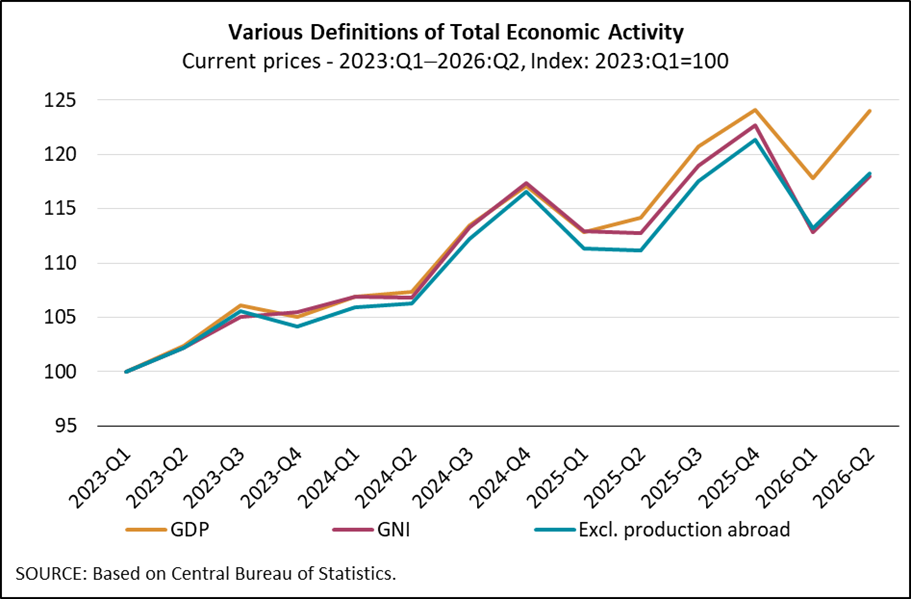
In August 2026, the Central Bureau of Statistics (CBS) carried out a comprehensive revision of the National Accounts data, revealing that exports manufactured abroad expanded unusually rapidly over the past two years: from 1.7 percent of GDP in 2023 to 3.5 percent of GDP in 2025. By the second quarter of 2026, its share had already risen to 5.8 percent of GDP, and according to the Research Department’s assessment in this forecast, it is expected to continue growing significantly in 2027.
Under National Accounts definitions, production abroad that is included in gross domestic product reflects Israeli companies’ production of goods that are sold overseas through subcontractors or affiliated companies abroad, without crossing Israel’s borders. In the Israeli case, this mainly refers to very large revenues from the sale of advanced technology products manufactured abroad on the basis of know-how developed in Israel, primarily by multinational corporations that operate and are registered in Israel, but are predominantly foreign-owned.
Standard GDP data may present a misleading picture of the level of domestic activity when they include production carried out abroad, especially when this involves foreign-owned companies. Below we explain why this component does not reflect domestic activity or the underlying forces operating in the economy.
First, production abroad does not use domestic productive capacity. It does not require local capital or Israeli labor and does not depend on domestic labor productivity. Therefore, growth in production abroad, and in the GDP derived from it, does not indicate a genuine expansion in the economy’s productive capacity or greater utilization of its resources. In addition, the increase in value added and income generated by production abroad flows largely to foreign shareholders and is not directly reflected in higher domestic wages, household income, or local demand. Accordingly, unlike GDP, gross national income (GNI), which reflects the income of Israeli residents, did not rise along with the increase in production abroad (Figure 1). The economy does benefit from corporate tax receipts, but the applicable tax rate is generally reduced, and the increase in such revenues is far smaller than the increase recorded as a result of the rise in other GDP components. Consequently, official GDP may grow without reflecting a parallel improvement in citizens’ incomes or household welfare.
Although production abroad increases the surplus in the goods and services account, its growth during 2023–2025 was accompanied by an almost identical increase in income attributed to foreign investors, so its net contribution to the current account was small. Its contribution to shekel appreciation is limited to the portion that is actually converted into shekels—mainly corporate tax payments, which are generally levied at reduced rates.
The use of an “adjusted” GDP measure is also applied in other countries, including Ireland and Denmark. In Denmark, production abroad amounts to about 8 percent of GDP, but ownership is domestic, so the profits remain within national income. In Ireland, ownership is foreign, and adjusted gross national income (GNI*) is about 45 percent lower than GDP. Public debt ratios there are also presented relative to that measure. In Israel, production abroad is recorded in GDP as in Denmark and Ireland, but its profits flow to foreign owners, as in Ireland.
Therefore, in macroeconomic analysis and in formulating forecasts for inflation, employment, and wages, it is appropriate to focus on GDP excluding production abroad. Netting out production and sales abroad provides a more accurate picture of the underlying forces in the domestic economy, including demand, supply constraints, labor market tightness, and similar factors.
This is also true when assessing fiscal ratios, foremost among them the debt ratio, which is commonly presented as a percentage of GDP in order to evaluate fiscal sustainability. Since the effective tax rate that can be levied on profits from production abroad is significantly lower than the average tax burden on GDP (around 25%), a decline in the debt-to-GDP ratio—when GDP includes production abroad—may be misleading. This is all the more true when the income in question belongs to foreign-owned multinational corporations, which may also relocate their profit centers if tax rates cease to be competitive.
[1] The forecast was presented to the Bank of Israel Monetary Committee on October 20, 2026, prior to the decision on the interest rate made on October 21, 2026.