To view this press release as a word file, click here
- Exchange Rate Development
A strengthening of the shekel alongside a mixed trend of the dollar worldwide.
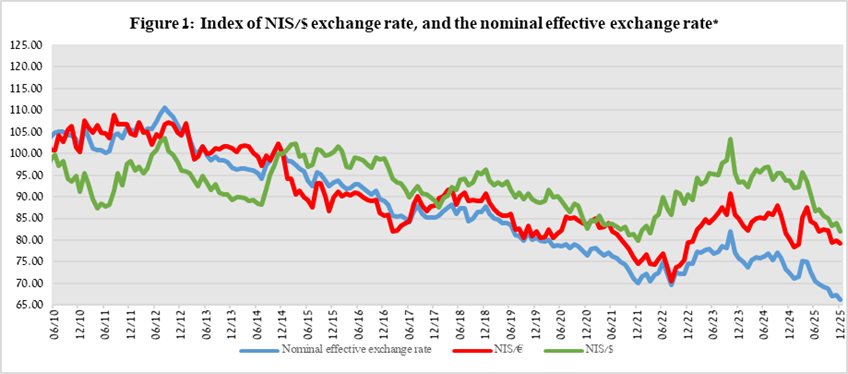
In the fourth quarter of 2025, the shekel strengthened by approximately 3.5 percent vis-à-vis the US dollar and the euro. In addition, the shekel strengthened by a similar rate against the currencies of Israel's main trading partners, in terms of the nominal effective exchange rate (i.e., the trade-weighted average shekel exchange rate against those currencies).
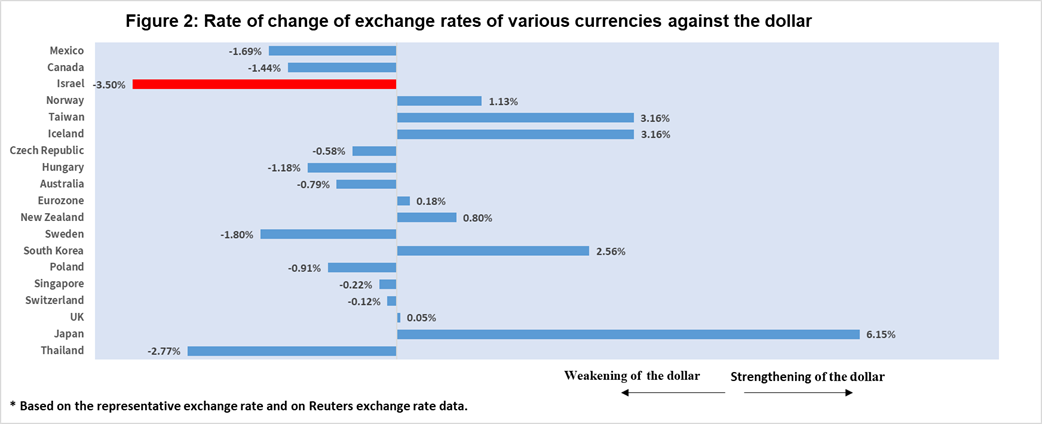
Worldwide, the trend of the US dollar was mixed against most of the world’s major currencies (Figure 2). Among other things, the dollar strengthened by about 6.2 percent against the Japanese yen, 0.2 percent against the euro, and about 0.1 percent against the British pound, but weakened by about 1.4 percent against the Canadian dollar.
- Exchange Rate Volatility
Decline in actual volatility alongside a decline in implied volatility
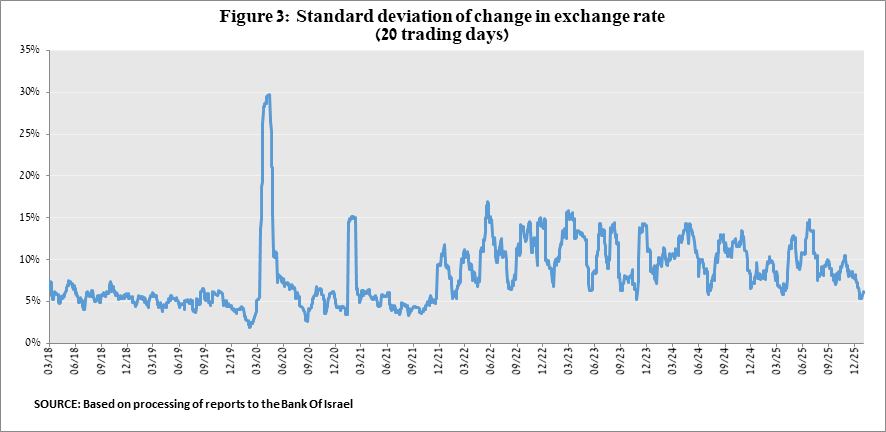
The average actual standard deviation of changes in the shekel/dollar exchange rate, which represents its actual volatility, declined by 1.3 percentage points during the quarter, to an average level of 8.1 percent.
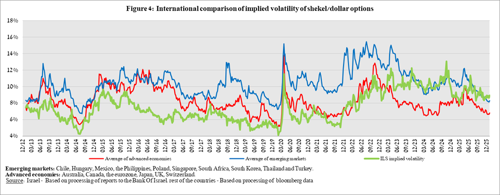
The average implied volatility in over-the-counter shekel/dollar options—those traded outside the stock exchange—which is an indication of expected exchange rate volatility, declined by 0.5 percentage points during the quarter, to an average level of about 8.8 percent at the end of the quarter.
This is alongside the average level of implied volatility in foreign exchange options in emerging markets, which declined by 1.0 percentage point compared to the previous quarter, to 8.6 percent at the end of the quarter. There was a similar decline in advanced economies, to 7.0 percent at the end of the quarter (Figure 4).
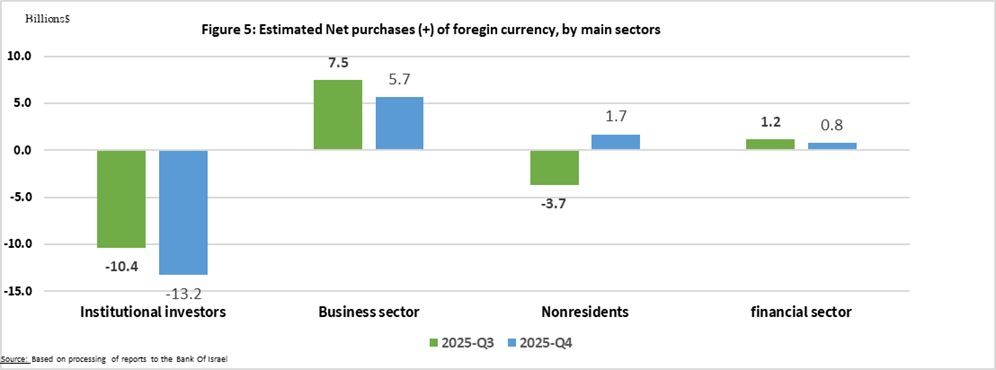
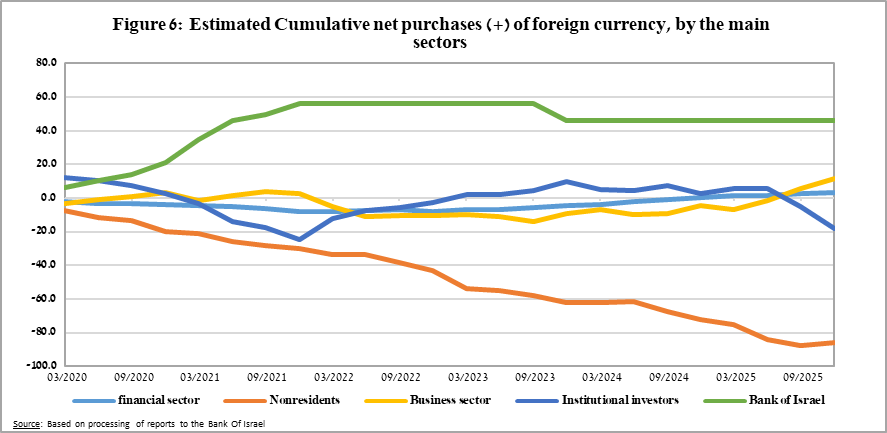
An estimate of activity by the main segments in the foreign exchange market indicates heterogeneous activity. In the fourth quarter, there were net foreign exchange sales by institutional investors, which supported the strengthening of the shekel, while the other segments—nonresidents, the business sector, and the financial sector—made net purchases, though at varying levels of intensity. Institutional investors—pension funds, provident funds, and insurance companies—continued to make net sales of foreign exchange, totaling about $13.2 billion, during the quarter, compared with $10.4 billion in the third quarter. At the same time, nonresidents moved to net foreign exchange purchases, totaling about $1.7 billion in the fourth quarter, compared to sales of about $3.7 billion in the third quarter. The business sector continued to make net foreign exchange purchases, though at a more moderate volume of about $5.7 billion, compared with $7.5 billion in the third quarter. The financial sector (mainly the banks) made net foreign exchange purchases totaling about $0.8 billion in the fourth quarter, down from purchases of about $1.2 billion in the third quarter.
- Trading Volume in the Foreign Currency Market—Tables and Figures
Trading volume vis-à-vis the domestic banking system[3]
The average daily trading volume increased by about 21.5 percent during the fourth quarter to $14.9 billion, with most of the increase coming from swap transactions.
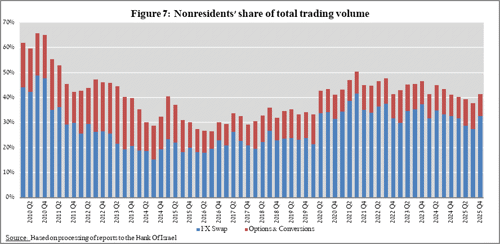
Nonresidents' share of total trading volume vis-à-vis the domestic banking system (spot and forward transactions, options, and swaps) increased by about 3.5 percentage points to about 41.5 percent at the end of the fourth quarter.
|
Forex transactions with domestic banks, by instruments and derivatives ($ million) |
||||||
|
|
|
Conversions (1) |
Swaps1 (2) |
Cross Currency swap2 (3) |
Options3 (4) |
Total volume of trade (1)+(2)+(3)+(4) |
|
Fourth quarter 2025 (Not final) |
Total |
235,850 |
633,218 |
3,883 |
21,512 |
894,462 |
|
Daily average (60 days) |
3,931 |
10,554 |
65 |
359 |
14,908 |
|
|
Nonresidents |
71,723 |
291,710 |
1,199 |
7,220 |
371,852 |
|
|
of which Foreign financial institutions |
70,972 |
291,710 |
1,199 |
7,220 |
371,100 |
|
|
Residents |
164,126 |
341,507 |
2,685 |
14,292 |
522,610 |
|
|
of which Real sector |
45,082 |
41,740 |
242 |
7,940 |
95,004 |
|
|
Financial sector |
35,955 |
134,075 |
1,974 |
1,114 |
173,118 |
|
|
Institutions (incl. insurance companies) |
59,083 |
127,715 |
0 |
3,148 |
189,947 |
|
|
Individuals |
5,993 |
479 |
0 |
52 |
6,523 |
|
|
Other4 |
752 |
0 |
0 |
0 |
752 |
|
|
Domestic banks5 |
8,857 |
17,111 |
285 |
1,544 |
27,796 |
|
|
Third quarter 2025 |
Total |
208,483 |
537,265 |
2,983 |
23,990 |
772,722 |
|
Daily average (63 days) |
3,309 |
8,528 |
47 |
381 |
12,265 |
|
|
Nonresidents |
70,118 |
212,365 |
2,165 |
9,636 |
294,283 |
|
|
of which Foreign financial institutions |
69,175 |
212,365 |
2,165 |
9,601 |
293,305 |
|
|
Residents |
138,366 |
324,900 |
819 |
14,354 |
478,439 |
|
|
of which Real sector |
43,596 |
29,418 |
300 |
6,642 |
79,957 |
|
|
Financial sector |
32,177 |
136,158 |
17 |
337 |
168,689 |
|
|
Institutions (incl. insurance companies) |
34,714 |
118,332 |
300 |
5,544 |
158,890 |
|
|
Individuals |
6,398 |
340 |
0 |
54 |
6,793 |
|
|
Other4 |
943 |
0 |
0 |
35 |
978 |
|
|
Domestic banks5 |
8,783 |
22,259 |
80 |
1,071 |
32,193 |
|
|
1 Only one leg of the swap, i.e., the nominal value of the transaction (in accordance with the BIS definition) |
||||||
|
2 The exchanged founds through Cross Currency Swap transactions considered for the volume, as one leg only in cases where the two legs offset each other. |
||||||
|
3 The national value, that includes purchases and sales of put and call options. |
||||||
|
4 Including other entities such as portfolio managers, nonprofit organizations, national institutions, and those not included elsewhere. |
||||||
|
5 Total interbank trade, divided by 2 |
||||||
Estimated total trading volume[4]—domestic banking system and foreign reporting entities
The estimated total activity in transactions against the shekel, as reflected in reports from the domestic banking system and foreign reporting entities, indicates that nonresidents’ relative share of trading volume in spot and forward transactions (excluding swaps and options) was about 85 percent in the fourth quarter.
Trade between nonresidents constituted about 77 percent of the volume, which had a daily average of about $17.9 billion.
|
|
|
Relative share of total trading volume |
|
|
||
|
|
|
Trade between nonresidents |
Trade between a nonresident and a resident1 |
Trade between the domestic banking system and residents |
Total volume ($ million) |
Daily average ($ million) |
|
2025-Q4 |
Trading volume in spot and forward transactions |
77.0% |
8.1% |
14.9% |
1,072,095 |
17,868 |
|
Trading volume in swap and options transactions |
55.6% |
21.6% |
22.8% |
1,567,175 |
26,120 |
|
|
Q3 2025 |
Trading volume in spot and forward transactions |
77.5% |
8.6% |
14.0% |
948,434 |
15,055 |
|
Trading volume in swap and options transactions |
57.1% |
18.5% |
24.4% |
1,382,075 |
21,938 |
|
|
1 Trade between a nonresident and a resident includes: (a) reports by foreign reporting entities regarding transactions with residents; and (b) reports by domestic banks regarding transactions with nonresidents. |
||||||
[1] For additional information on the segments’ activity in the foreign exchange market, see “Statistical Bulletin” 2024—Chapter D.
[2] The main segments presented do not make up the entire market—for additional information, see the section on “The Database of Foreign Exchange Market Activity” in the Bank of Israel’s “Statistical Bulletin” for 2024
[3] From the beginning of 2020, the data do not include branches of foreign banks in Israel.
[4] Total trading volume is an estimate of total activity in transactions against the shekel, based on reports by the domestic banking system and by foreign reporting entities.